
Brussels Economic Monitor 3/2026: SOTEU: State of the European Unbalance
China Shock 2 and the Reality of De-Risking in Turbulent Times
Lesedauer: 3 Minuten
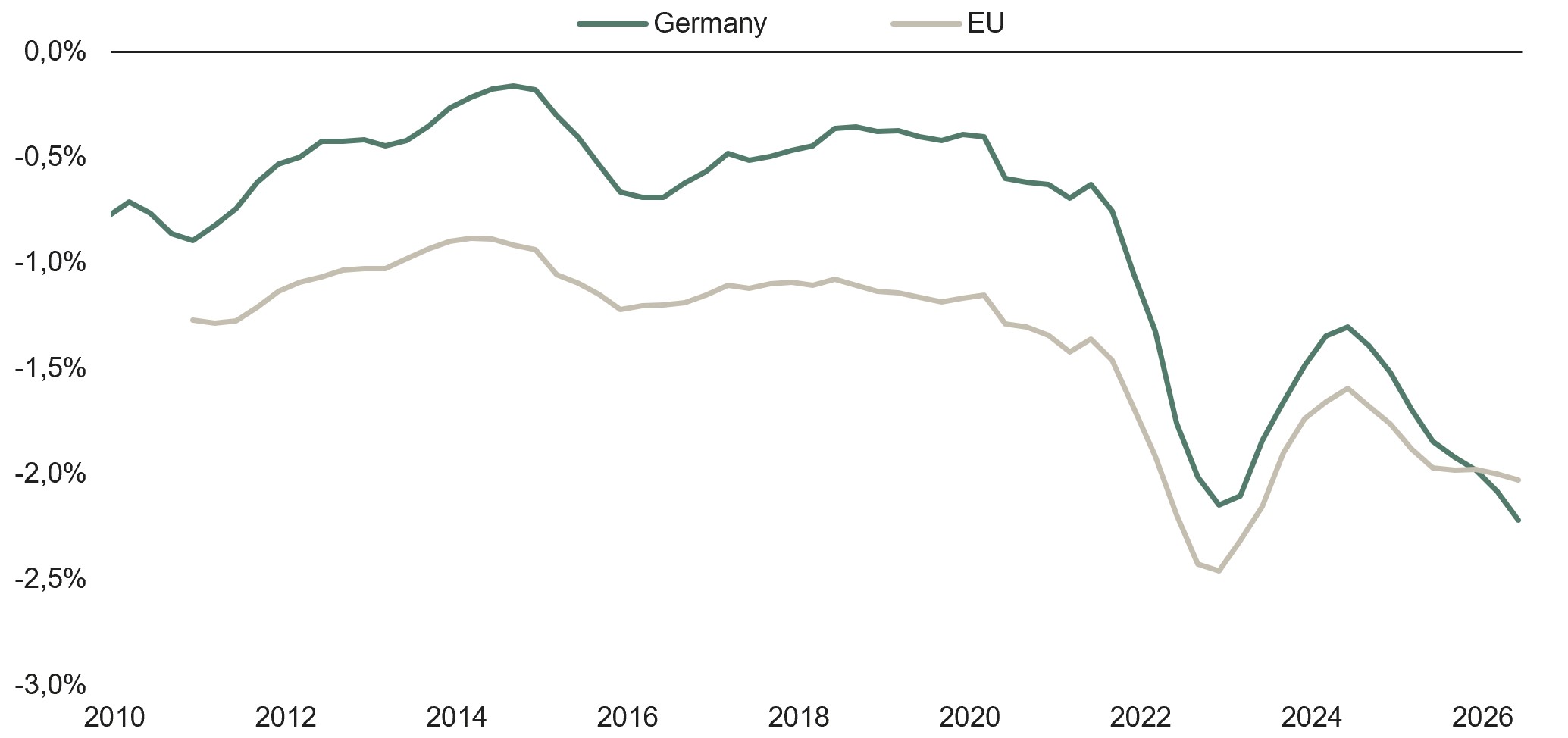
“Let me be clear: we will use all the tools at our disposal to rebalance our relationship. Words are good. But deeds are better.” In her recent State of the European Union speech, Commission President Ursula von der Leyen formulated clear expectations of substantial concessions from the ongoing talks with China to mitigate the unbalanced trade relationship. Following years of structural divergence, the EU is now registering a record-breaking trade deficit with China of €1 billion per day.
Recent years have seen significant pressure on manufacturing employment and industrial competitiveness across Europe, particularly in Germany’s automotive and engineering sectors. Previously diverging views among policymakers and business leaders are increasingly converging around a more assertive approach towards China. The criticism targets, above all, industrial overcapacity, unfair subsidies and an artificially undervalued currency.
To counter these practices, the Commission launched Trade and Investment Consultations with the Chinese government, setting “an ambitious timeline to deliver tangible results by October”. It remains uncertain whether Beijing is ready and willing to grant satisfactory concessions. The upcoming months will require walking a fine line between engagement and escalation, making sure to serve the European interest. The EU’s approach of de-risking and reducing dependencies on China inherently means a higher degree of diversification. Ultimately, Europe’s challenge is not simply to reduce its trade deficit or to diversify its supply chains, but to improve its own structural competitiveness without unduly undermining the economic interdependence on which European industry itself depends.
Trade balance in goods with China
In % of GDP, rolling 4-quarter average
Key topics covered in the Brussels Economic Monitor 3/2026:
- Germany’s trade deficit with China has reached a new record
- An undervalued yuan amplifies global imbalances
- Europe is on track to host only 6% of global AI compute by 2031
- The EU growth shortfall has become more pronounced
- Eurozone GDP per head has risen relative to the US
TAKE: Two years after the Draghi Report, Europe faces an even more challenging global environment, marked by geopolitical rivalry, trade barriers, Chinese overcapacity and strategic dependencies. The single market is therefore becoming an ever more important source of growth and resilience. Unlocking its potential requires removing internal barriers, thereby enabling firms to scale and accelerate the adoption of productivity-enhancing technologies. It also means defending market-based competition against practices that try to exploit the EU’s economic openness. Europe has the resources and scale to avoid the “slow agony” Draghi warned of. What it needs is the political resolve to act together. A key test will come when the October deadline for negotiations with China expires. If talks fail to deliver meaningful progress towards rebalancing the relationship, the EU may ultimately have little choice but to take action. In a world of strategic competition and weaponised interdependence, Europe’s economic weight counts only if it is prepared to use it.
More Editions
- 2/2026: Sovereign Software on the Rise?!
- 1/2026: „Made in Europe”: Ready for Resilience?!
- 4/2025: Diverging allies face stormy waters
- 3/2025: One year after Draghi’s wake-up call
- 2/2025: Single Market Stategy − Europe’s Best Bet in an Unstable World
- 1/2025: From Crisis to Competitiveness − The Imperative for the Clean Industrial Deal and more